

From the Field with Steve Gamble
Sometimes, the most interesting discovery during a wireless network assessment isn't something that's missing. It's something that's still there.
Over my years working as a Wireless Engineer, I've learned that wireless networks have a way of evolving. Businesses expand, equipment gets upgraded, offices are renovated, and technology changes. But not everything from the old network necessarily disappears.
And occasionally, what gets left behind can raise some interesting questions.
An Unexpected Discovery
During a wireless assessment I conducted at a commercial office facility, I was evaluating the organization's existing wireless infrastructure. The environment had multiple access points distributed throughout the office, providing adequate wireless coverage across the areas being assessed. But as I examined the network more closely, I noticed something unexpected.
An older wireless access point was still broadcasting the same network name, or SSID, used by the organization's existing wireless infrastructure. That immediately caught my attention. Was this access point intentionally part of the current network? Had it been overlooked during a previous upgrade? Was it still needed?
I also identified another wireless device providing a relatively large coverage area, although its continued purpose was uncertain. Neither discovery automatically meant something was wrong. But both raised questions worth investigating. Because in wireless engineering, understanding what's operating in your wireless environment can be just as important as understanding how well your network is performing.
The illustration below represents the kind of situation I encountered: an older access point still operating alongside newer wireless infrastructure, raising questions about its purpose, configuration, and whether it still belonged in the network.
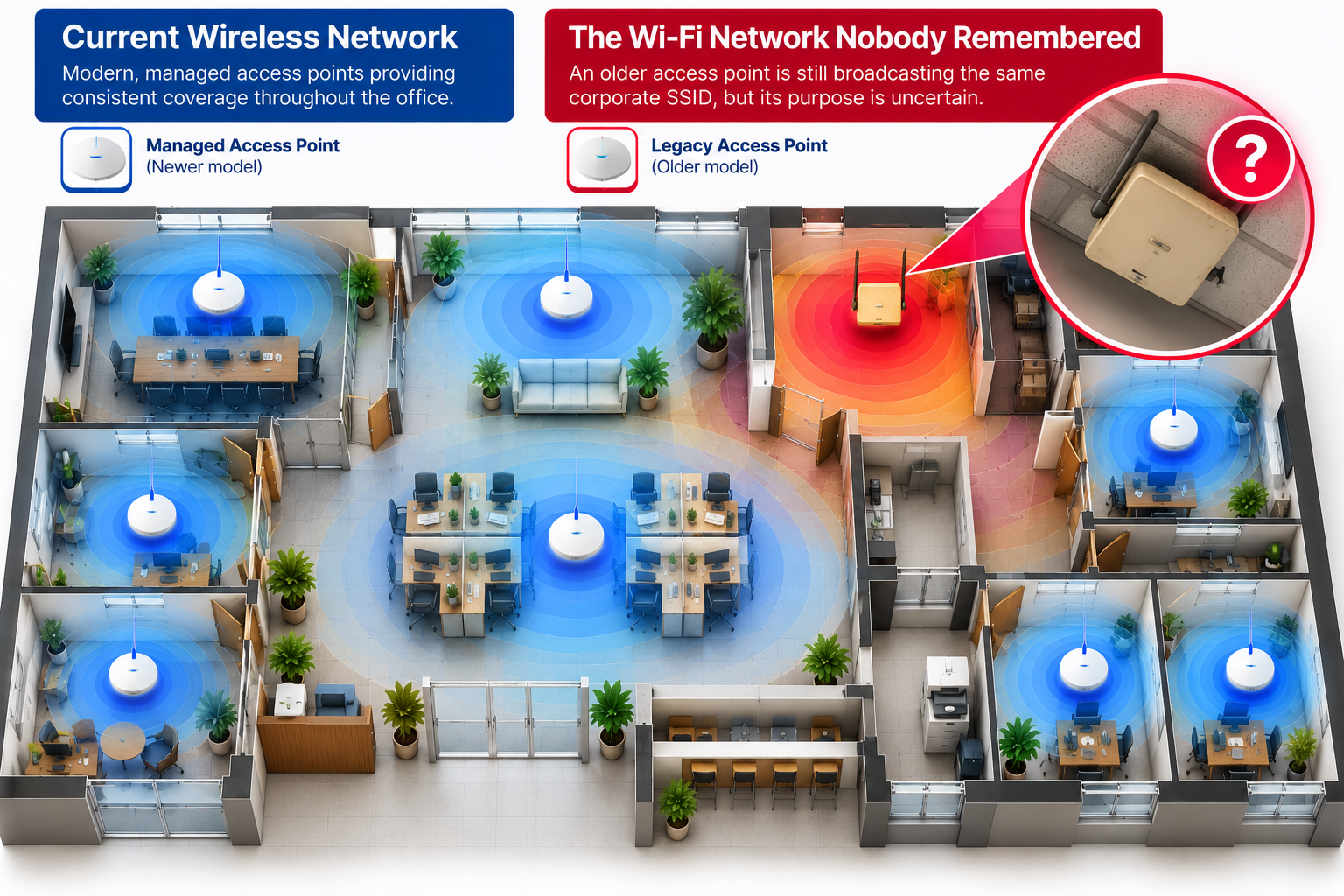
Figure 1. Conceptual illustration of an older wireless access point operating alongside newer network infrastructure. Identifying unexpected equipment can reveal gaps in an organization's understanding of its wireless environment. Not actual RF survey data.
How Wireless Networks Accumulate History
Think about how technology changes within a typical business. A company might start with a few access points supporting a small office. As the business grows, additional equipment is installed. Several years later, the organization upgrades to newer wireless technology.
Perhaps an access point is relocated. Another is replaced. A temporary device is installed to address a connectivity issue. Eventually, the network may contain equipment from different generations, installed for different reasons, and managed by different people. This isn't necessarily the result of poor planning. It's often simply how technology environments evolve over time.
The challenge comes when changes aren't consistently documented or older equipment isn't properly reviewed and decommissioned. An access point that once served an important purpose may continue operating long after the original need has changed. And unless someone takes a closer look, its presence might go unnoticed.
Why an Older Access Point Matters
You might wonder: If an older access point is still working, why should anyone be concerned?
That's a reasonable question. The answer depends on how the device is configured, managed, and integrated into the existing wireless environment.
For example, an older access point may be operating with different security settings, outdated firmware, or wireless configurations that no longer align with the organization's current standards. It might also be advertising the same network name (SSID) as the newer access points without being managed or configured in the same way. Depending on its authentication settings and network connectivity, this could create an inconsistent experience for devices attempting to connect.
There's also the question of wireless efficiency. Depending on its configuration and the devices it supports, older equipment may use lower data rates or legacy wireless features that increase airtime consumption and reduce overall efficiency. None of these conditions should be assumed simply because an access point is old. But they illustrate why identifying and evaluating existing wireless equipment is important.
An access point doesn't have to be broken to deserve a closer look.
What a Wireless Assessment Can Reveal
When I conduct a wireless assessment, I'm interested in more than the access points listed on a network diagram. I want to understand what's operating in the environment. That means examining the wireless networks being advertised, identifying access points within range, reviewing channel usage, and comparing observed equipment against the organization's known infrastructure.
When an unfamiliar or unexpected device appears, the next step is investigation—not assumption. Is the device authorized? Who manages it? What purpose does it serve? Does its configuration align with the current network design? And is it still needed?
In the commercial office assessment, identifying the older access point and the additional wireless device helped highlight areas that warranted further review. The findings didn't establish that either device was causing a connectivity problem. What they provided was something equally important: greater visibility into the existing wireless environment. That visibility helps organizations make better-informed decisions about their infrastructure.
The Value of Knowing What You Have
One lesson I've carried throughout my engineering career is that effective troubleshooting begins with understanding the existing environment. As businesses grow and technology evolves, it's easy for organizations to lose track of equipment installed by different teams, vendors, or service providers.
A wireless assessment can help identify those discrepancies, revealing equipment that may have been overlooked, is no longer needed, or requires further evaluation.
These discoveries may not be dramatic, but they provide something valuable: the information needed to make better decisions about the network.
The Lesson I've Carried Forward
The older access point I encountered during that commercial office assessment reminded me of something I've learned repeatedly over the years:
Wireless networks don't just need to be maintained. They need to be understood.
As technology evolves, it's worth periodically reviewing the equipment that remains in operation. Not every older device needs to be replaced. Not every unexpected access point represents a problem. And not every wireless issue requires purchasing something new.
Sometimes, the most useful first step is simply asking:
Do we really know everything that's operating in our wireless environment?
Because before you can confidently improve a network, you need to understand what's already there. And occasionally, the most important discovery is the access point nobody remembered.