

From the Field with Steve Gamble
When it comes to Wi-Fi, there's a common assumption that more is always better. More access points. Stronger signals. Greater coverage. It sounds logical. After all, if a wireless network is struggling, wouldn't increasing its coverage or signal strength help?
Not necessarily. One of the more interesting lessons I've learned over my years as a Wireless Engineer is that wireless networks can work against themselves when they're not properly designed. Sometimes, the problem isn't that you have too little Wi-Fi.
It's that you have too much of it in the wrong places.
A Healthcare Facility with Plenty of Wi-Fi
During a wireless assessment I conducted at a healthcare facility, I encountered an environment where the existing wireless infrastructure provided substantial coverage throughout the building.
At first glance, that might sound like a good thing. But as I evaluated the access point configuration, signal propagation, and roaming characteristics, I began identifying conditions that could contribute to an inconsistent wireless experience.
Several access points were operating at relatively high transmit power levels, approximately 20–23 dBm. Meanwhile, many of the mobile client devices using the network were likely transmitting at considerably lower power levels.
That difference matters more than most people realize. This imbalance could allow client devices to detect a strong signal from an access point at distances where their own transmissions might not be received as reliably by that access point. In addition, the oversized coverage areas created opportunities for overlapping cells and roaming problems. The wireless network wasn't necessarily lacking coverage. The concern was whether that coverage was properly balanced.
Wi-Fi Is a Two-Way Conversation
I often explain wireless communication using a simple analogy. Imagine two people trying to have a conversation across a large room. One person has a powerful microphone and speaker system. The other is speaking in a normal voice. The first person can easily be heard across the room. But that doesn't mean they can hear the other person clearly.
Wi-Fi operates in a similar way. Your access point communicates with your laptop, phone, or tablet, but those devices must also transmit information back to the access point. If the access point's transmit power is significantly higher than the client's, the network can create an imbalance. Your device might detect a strong wireless signal even though its ability to communicate reliably in the opposite direction is limited.
That's one reason increasing transmit power isn't always the answer to poor wireless performance.
When Access Points Compete with Each Other
Another challenge I frequently evaluate is overlapping wireless coverage. Some overlap is necessary, especially in environments where users move throughout a building and need their devices to transition between access points. But excessive overlap can become problematic when nearby access points operate on the same channels and compete for airtime, particularly in environments with high wireless activity.
Instead of efficiently serving their intended areas, access points may extend coverage farther than needed. Some client devices may remain associated with an access point longer than desirable, even when another access point could provide a better connection. This behavior, often called a sticky client, can be influenced by the device's roaming logic and the surrounding RF conditions.
Imagine walking from one end of an office to another while your phone continues trying to communicate with an access point several rooms behind you. Although another access point may be nearby, the device might not transition to it as quickly as expected.
The result can be inconsistent performance, particularly for applications that depend on continuous connectivity. The illustration below demonstrates how two different approaches to access point placement and transmit power can produce very different wireless environments—even within the same building layout.
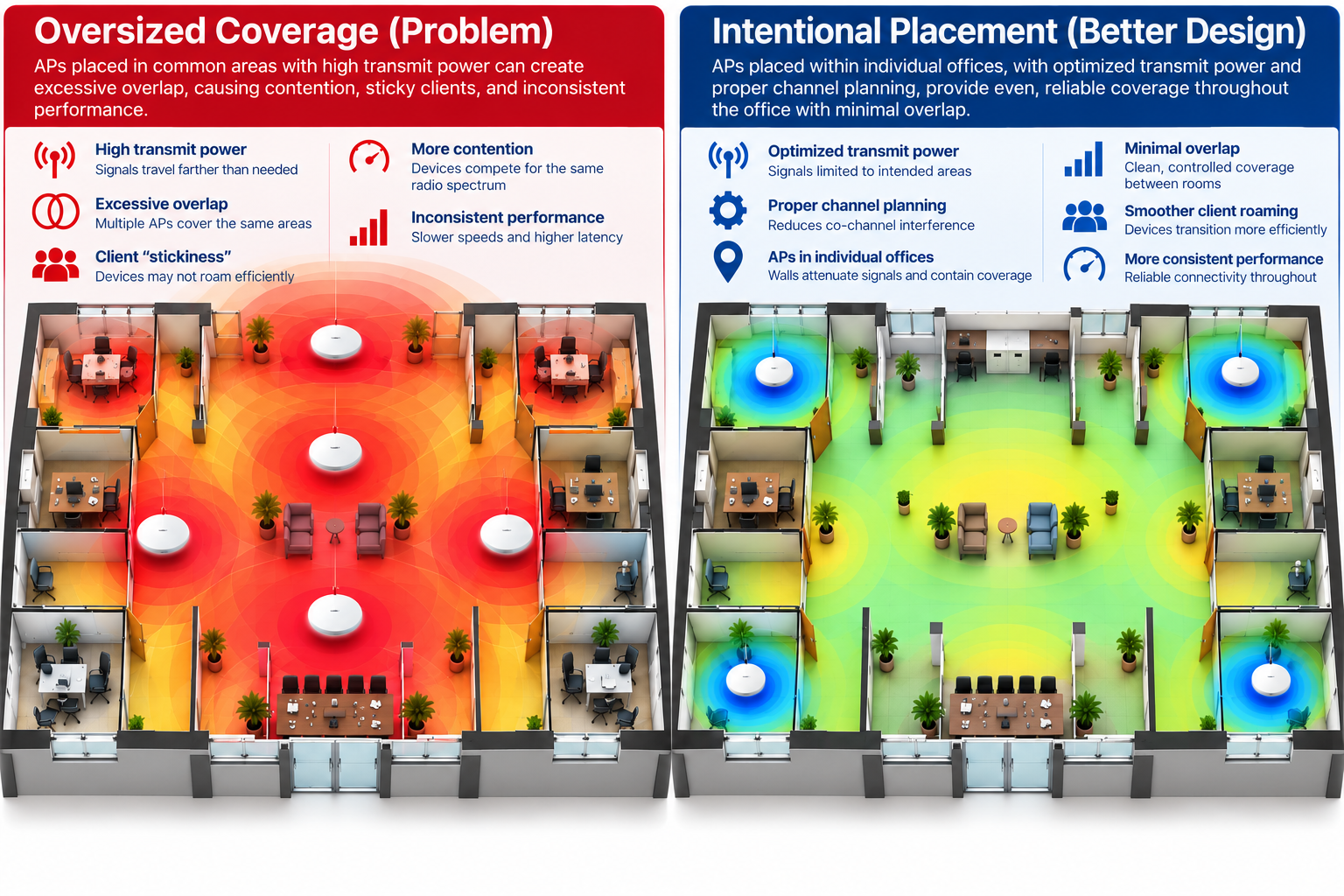
Figure 1. Conceptual comparison of two wireless network designs. On the left, excessive transmit power and overlapping coverage may contribute to contention and roaming challenges. On the right, intentional access point placement, wall attenuation, and appropriate RF settings illustrate how more balanced coverage can be achieved. Actual performance must be verified through wireless assessment and testing.
Why Adding Another Access Point Isn't Always the Solution
When someone experiences weak or unreliable Wi-Fi, one of the first suggestions they often hear is to install another access point. Sometimes that's exactly what's needed. But adding equipment without understanding the existing wireless environment can introduce new problems. Every additional access point becomes another radio operating within a limited amount of available spectrum. If channels, transmit power, and placement aren't carefully considered, the new equipment may contribute to the same contention the network was already experiencing.
During the healthcare assessment, my recommendations included reviewing transmit power levels, improving channel planning, and reconsidering access point placement. The objective wasn't simply to increase or decrease the number of access points. It was to create a more intentional wireless design that balanced coverage, capacity, and mobility.
In fact, a proposed redesign included additional access points positioned and configured differently. That may sound contradictory, but it illustrates an important principle: more access points can be beneficial when they are part of a properly engineered design.
It's not necessarily how many access points you have. It's how effectively they work together.
Finding the Right Balance
When I evaluate a wireless network, I look beyond whether a signal reaches a particular location. I want to understand how the access points interact, how client devices behave, and whether the network supports the way people use it. That involves evaluating factors such as transmit power, channel allocation, coverage overlap, signal quality, and roaming behavior.
A good wireless design doesn't aim to make every access point transmit as far as possible. It aims to provide the right amount of coverage and capacity in the right locations. And that balance can look very different in a medical clinic, a corporate office, a school, or a residence.
The Lesson I've Carried Forward
Over the years, I've learned that some wireless problems can't be solved by simply turning up the transmit power—or getting the APs “turnt,” as a colleague of mine likes to say.😊 Sometimes, improving a network means reducing unnecessary coverage, adjusting transmit power, changing channel assignments, or rethinking where access points are installed. Before adding another access point or increasing signal strength, ask yourself:
Does my network need more Wi-Fi, or does it need better-designed Wi-Fi?
Because when it comes to wireless networking, more isn't always better. Better is better.