

From the Field with Steve Gamble
When people experience Wi-Fi problems, their first instinct is often to look at the equipment. Is the infrastructure outdated? Are there enough access points? Should they upgrade to the latest Wi-Fi technology? Those are reasonable questions. But after years of working as an RF Engineer, I've learned that some of the most frustrating wireless problems have very little to do with the equipment itself. Sometimes, the real problem is something you can't see.
When Everything Looks Fine, But Something Isn't
During a wireless assessment I conducted at a commercial office facility, I encountered a situation that reinforced an important lesson about wireless performance. The organization had a well-established wireless network with multiple access points providing coverage throughout its office space. From a signal-strength perspective, things looked good. In fact, my survey confirmed that wireless coverage was adequate throughout the areas being assessed.
But wireless coverage is only part of the story.
As I examined the area, the surrounding RF environment revealed several conditions worth investigating. The office was in a multi-tenant commercial building, surrounded by other businesses operating their own wireless networks. Several neighboring access points were using relatively wide wireless channels, potentially competing for some of the same radio spectrum. I also identified older wireless equipment that was still broadcasting a network name used by the organization's existing infrastructure. Another wireless device was operating with a relatively large coverage footprint, even though its continued use was uncertain. None of these observations necessarily meant the network was failing. However, they identified conditions that could contribute to wireless contention or inconsistent performance—factors that wouldn't necessarily be apparent from signal-strength measurements alone.
And that's where the real value of a wireless assessment becomes apparent.
Wi-Fi Doesn't Operate in Isolation
Think about a conversation in a crowded restaurant. You might be sitting directly across from someone, close enough to hear them clearly. But if several conversations happen around you, understanding every word becomes more difficult.
Wireless networks face a similar challenge. Wi-Fi operates using radio frequencies shared by other wireless devices. In an office building, shopping center, medical plaza, or residential neighborhood, multiple networks may be competing for access to the same limited spectrum. When nearby networks operate on the same channel, their devices generally must share airtime, potentially increasing the time spent waiting to transmit. Networks using partially overlapping channels can introduce additional interference, depending on their configuration and activity. Under certain conditions, this can reduce performance, increase latency, or contribute to inconsistent user experience. What's often overlooked is that your own equipment may be functioning exactly as designed. The challenge isn't necessarily a faulty access point. It's the wireless environment surrounding it.
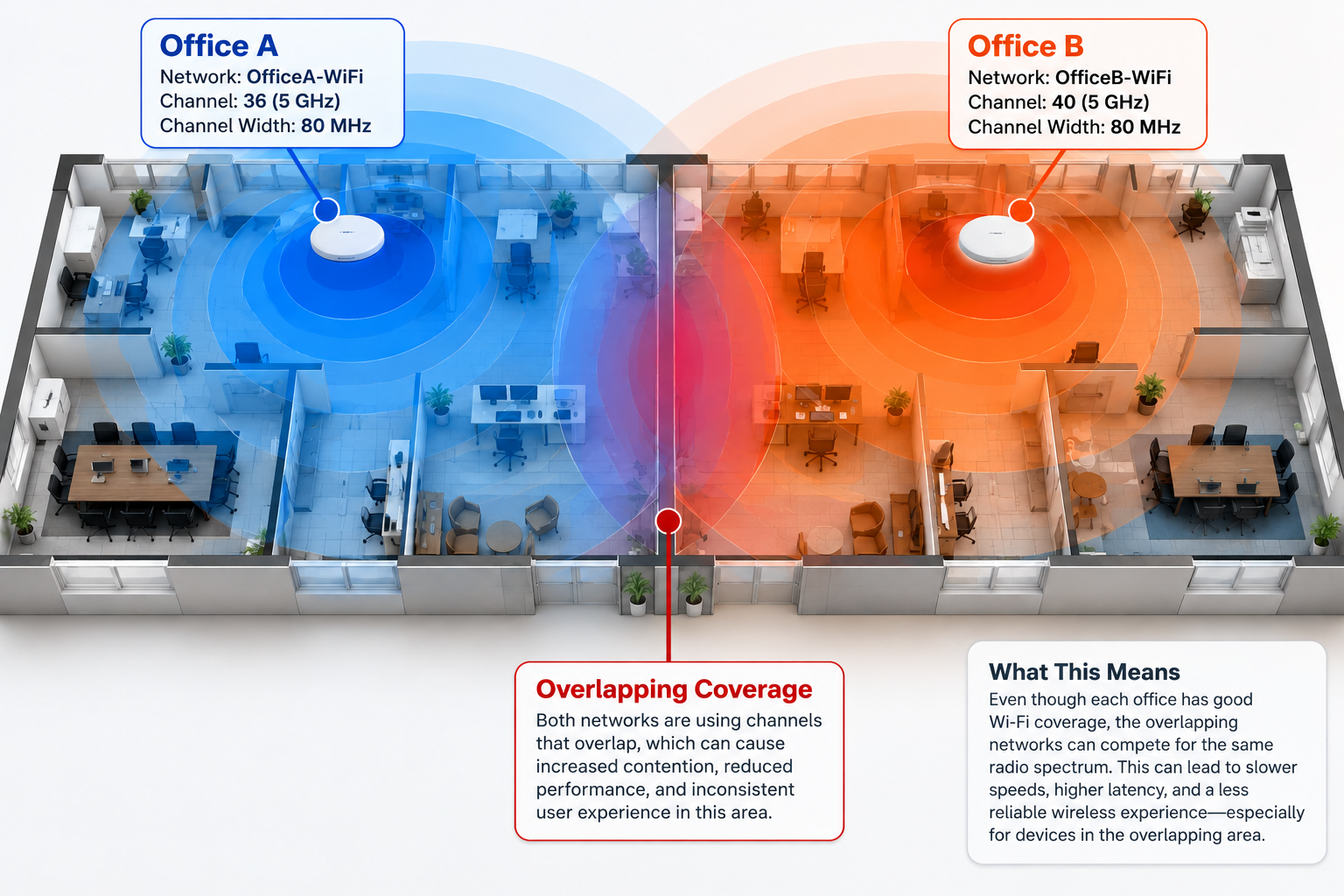
Figure 1. Conceptual illustration of neighboring wireless networks with overlapping channel usage. Even with adequate signal coverage, shared spectrum can contribute to contention and reduced performance.
More Isn't Always Better
One thing I've learned through wireless engineering is that more doesn't always mean better. More access points, stronger signals, and wider wireless channels don't automatically translate into better performance. For example, wider channels can support higher potential data rates, but they also occupy more radio spectrum. In environments where neighboring networks compete for available channels, this can increase contention and affect performance.
The key is understanding that wireless networks perform best when coverage, channel planning, and equipment configurations are designed around the environment—not simply maximized.
Looking Beyond the Signal
When I conduct a wireless assessment, I'm not simply looking for areas where the signal is weak. I'm trying to understand how the wireless environment behaves. That means examining signal strength, signal-to-noise ratio, channel utilization and overlap, access point placement, transmit power, and potential sources of interference. I'm also interested in how the network is being used.
A wireless network supporting a few laptops in a small office has different demands than one supporting mobile workstations in a healthcare facility or dozens of devices moving throughout a busy commercial space. Understanding those differences is important because there isn't one configuration that works best for every environment. In the commercial office assessment I mentioned earlier, the findings helped identify areas worth investigating and potential adjustments to consider. They provided a clearer understanding of the wireless environment and a more informed basis for future decisions.
That's what good wireless troubleshooting should accomplish: replace assumptions with evidence.
The Lesson I've Carried Forward
If there's one lesson I've taken from years of evaluating wireless networks, it's this: You can't always solve a Wi-Fi problem by changing what you can see. Sometimes, you first need to understand what's happening in the air around you.
Before replacing equipment, adding another access point, or increasing transmit power, it's worth asking a different question: Do we understand what's causing the problem?
Because the best wireless solution isn't necessarily the newest equipment or the strongest signal. It's a network designed and optimized for the environment in which it operates. And sometimes, discovering what you can't see is the first step toward making everything work better.